Top Playground Set Manufacturers in China
A Playground Set is more than a collection of slides, swings, and climbing frames. It must withstand repeated use, changing weather, and everyday wear. Demand also reflects a broader need for places where children can move and play. Grand View Research estimated the global playground equipment market at USD 5.41 billion in 2023, with projected growth of 5.3% annually from 2024 to 2030. The figure signals a growing market, but it does not prove that every supplier offers dependable products.
Public health research adds important context. A 2019 study in The Lancet Child & Adolescent Health, based on data from 1.6 million students, found that 81% of adolescents aged 11–17 did not meet recommended activity levels. Play spaces are not a complete solution. Still, thoughtful design can make movement more inviting.
This guide introduces leading Playground Set manufacturers in China and the practical questions buyers should ask. Compare materials, welds, coatings, component options, quality checks, and installation support. Request product specifications and test documentation, then confirm which standards apply in your destination market. The U.S. Consumer Product Safety Commission’s Public Playground Safety Handbook is one useful reference for buyers serving the U.S. market. A polished catalogue is not enough. Factory capability matters, too. And a small detail—such as a sharp edge, unclear assembly instruction, or poorly protected joint—can change the user experience. Supplier claims deserve verification; this review considers both strengths and points that warrant a closer look.
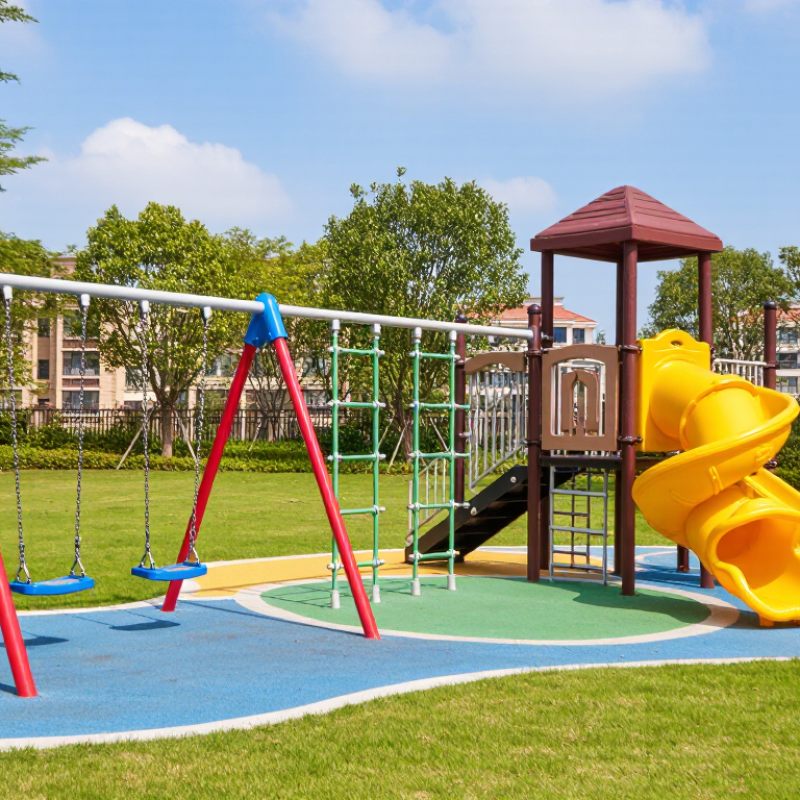
Overview of China’s Playground Set Manufacturing Industry
China’s playground-set manufacturing industry combines metal fabrication, plastics processing, surface finishing, and assembly. The National Bureau of Statistics of China reported that manufacturing value added grew 5.0% in 2023. This is a broad industrial benchmark, not a playground-specific growth rate, so it should not be read as one. In production workshops, galvanized steel tubes may be cut and welded beside molded plastic panels and connectors. Quality depends on more than a neat finish: buyers should check material specifications, weld consistency, coating coverage, and documented testing.
Manufacturers serve domestic projects and overseas buyers, often adapting layouts to site dimensions, age groups, and climate exposure. The details matter. Coastal or humid locations can accelerate corrosion, while strong sun can fade or weaken some plastics. Ask suppliers for relevant load, weathering, and corrosion-test records, and confirm that drawings match the delivered set. Public industry data rarely separates playground equipment from broader manufacturing categories; that makes supplier-level evidence especially useful. A polished catalogue is not proof of performance.
Tips: Request a bill of materials, inspection photos, and test documentation for the exact model. Check anchor points and clearances on the installation plan. Small omissions can become expensive later.
China Playground Set Manufacturing: Demographic Demand Context
China’s 2020 population by age group, shown as a share of the total population.
Children aged 0–14 accounted for 17.95% of the population in the 2020 census. This demographic indicator provides context for family and community recreation demand; it is not a measure of playground-set production or sales.
Source: China’s Seventh National Population Census, Communiqué No. 5, National Bureau of Statistics of China.
Common Playground Set Types and Materials
Playground sets commonly combine swings, slides, climbing frames, and platforms. Smaller yards often suit a compact swing-and-slide unit, while schools may choose modular equipment with several activity zones. Climbing nets and balance elements add variety, but they need clear landing areas. A busy-looking set is not automatically a better one. Small details matter.
Materials shape durability and maintenance. Galvanized steel frames resist rust, while powder-coated finishes add another protective layer; chipped coatings still need attention. High-density polyethylene panels are smooth, colorful, and less prone to splintering than untreated wood. Rot-resistant timber offers a natural appearance, though it may require regular sealing and checks for cracks. Ropes and molded plastic can make climbing features lighter, but their connections deserve close inspection. Match materials to local weather, expected use, and available upkeep. That sounds simple, but it is easy to overlook. Before comparing manufacturers, check how posts are anchored, whether fasteners are covered, and if replacement parts are available. Even a well-built set needs routine inspection.
Leading Playground Set Manufacturers in China
Leading playground set manufacturers in China serve schools, parks, resorts, and community projects with equipment designed for different ages and spaces. Strong manufacturers combine practical design with controlled production. They should explain material choices, surface finishes, load limits, and maintenance needs in clear terms. Ask how steel parts are protected from corrosion and how plastic components handle sun exposure. Details matter. A well-planned set may include climbing panels, slides, and shaded seating, while leaving safe space around each activity. Manufacturing capacity alone does not prove product quality.
Tips: Request drawings, material specifications, and recent quality inspection records. Compare the proposed equipment with your site dimensions and expected age group. Ask who handles installation guidance and replacement parts. Clear answers are useful; vague promises are not.
When comparing leading playground set manufacturers in China, evaluate communication as carefully as price. A reliable supplier should flag design limits and explain what needs local review before installation. Check that instructions cover foundations, anchoring, and routine inspections. These details can be overlooked during purchasing. Even a polished catalog cannot show how equipment will fit a real site, so review the layout and access routes before placing an order.
Manufacturing Processes and Safety Standards
Playground equipment safety starts on the factory floor. Manufacturers typically cut and form steel, mold or machine plastic parts, then apply coatings and assemble frames. Inspect welds for gaps, sharp edges, and uneven finishing. Check that bolt ends are capped and moving joints operate smoothly. Small details matter. Materials should suit outdoor exposure, since sunlight, rain, and temperature changes can weaken components over time. Ask for material specifications and traceable inspection records, not just product photographs.
Tips: Request test reports for the exact model and configuration. Standards such as EN 1176 or ASTM F1487 may apply, depending on the destination and equipment type. Confirm the current edition and scope with a qualified testing body. A report for one design may not cover a modified version.
During production, documented checks should cover dimensions, coating thickness, fastener torque, and final assembly. Load and impact testing can reveal weak points, but test results do not replace correct installation or regular maintenance. Review instructions for fall zones, anchoring, and age suitability before shipment. Even a detailed checklist can miss a real-world issue; feedback from installers and operators should inform design updates.
How to Compare and Select a Chinese Manufacturer
Choosing a Chinese playground set manufacturer takes more than comparing prices and product photos. Ask for drawings, material specifications, and details about welding, surface finishing, and assembly. For steel parts, check the stated grade and coating process. For plastic components, ask how color, thickness, and UV resistance are verified. Specific answers matter. “High quality” alone tells you little.
Review the factory’s quality records and request a sample or a close inspection of a completed unit. Check weld seams, bolt access, edge finishing, and whether the instructions match the hardware in the package. Ask how the supplier tests load-bearing parts and documents inspection results. Then compare lead times, packaging, replacement-part availability, and who handles design changes. A low quote may exclude useful checks or protective packing. Not always, but it deserves a question. Video calls can reveal production details, though they cannot replace independent verification. Keep written records of agreed specifications; small wording gaps can become real differences in the delivered set. A tidy catalog is reassuring, but it is not proof.